AI Government Showcase 2026
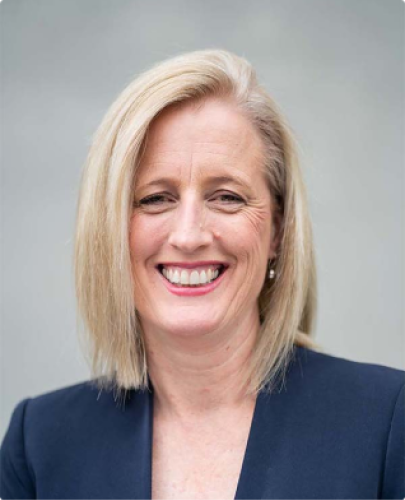
SENATOR THE HON KATY GALLAGHER
Minister for Finance
Minister for Women
Minister for the Public Service
Minister for Government Services
Senator for the ACT
It’s great to see so many people here with an interest in AI and government showcase event, and also I deeply appreciate being let out of the ERC room as we finally make all of those decisions that we need to for MYEFO.
Now, I don't need to tell anyone in this room about how generative AI is reshaping how businesses operate, how we learn and do research, and how we live and work. In government, if we get the adoption of AI right, it will mean better services, stronger policy making, faster decisions, and most importantly, from my point of view, better outcomes for the communities that we are here to serve.
For our workforce, it will mean changes to the way you all work. Hopefully, more interesting work supported by AI tools that maximise and optimise good human skills like insight, oversight, empathy, and judgement.
But there are risks and challenges, and really big public policy dilemmas to grapple with and resolve, including that this is all happening in real time, unfolding as quickly as technology does, presenting real challenges for public administrations, which do prefer time, controlled processes, and testing before moving to acceptance and adoption phases.
And just as the introduction of computers, the internet, and email dramatically changed the way the public service operated and provided services, so too, the AI revolution is doing the same.
And as we move from experimenting with AI across the APS to embedding it across our systems and building it into how services are delivered, it's worth going back and having a look at what's happened over the past 12 months since we released the AI plan for the Australian public service.
Back then, I asked three questions: How do we build trust with public servants and with the Australian people? How do we build capability across an organisation as big and as diverse as the APS? And how do we get the right tools into the hands of public servants to help them do their work?
Agencies were in a very different position a year ago. Adoption was uneven, and agencies faced many of the same questions, but were tackling them independently. Over the past year, we have accelerated our focus on supporting general use and building specific solutions to solve problems.
More than 110,000 public servants have now done the basic AI training, and AI foundation workshops have explained how AI works and where why there are guardrails governing its use. Public servants are really keen to learn about AI and are taking up training opportunities, formal and informal, in huge numbers.
There are now 133 chief AI officers across agencies leading the work along with secretaries for the adoption and use of AI in individual agencies.
Gov AI has come a long way in the last year. Gov AI Chat, the secure AI assistant built for the APS, is in beta. In September, 36 agencies were part of it, and more than 12,500 staff had access.
We've also created Gov AI Exchange to share what agencies have built and test new ideas through Gov AI hosting without setting up their own infrastructure.
And every agency now publishes an AI transparency statement explaining how and why it uses AI to be accountable and drive public trust.
The DTA, Department of Finance, and the APSC, all which fit within my portfolio responsibilities, have individual and specific responsibilities to drive the safe and effective adoption of AI across government. And whilst it is shared across those agencies, they are working really well to support, promote, and deliver the AI plan across the APS.
And whilst general tools are really important in driving that uptake, consistent uptake across the APS, we've seen great examples of specific use cases to help entities doing their work.
For example, the National Library of Australia is using AI to assist in transcribing its 150,000 hours of oral history recordings. An hour of audio now takes around 90 seconds.
The Fair Work Ombudsman is using AI to build a new case management platform. It's taken about four and a half months, when an earlier attempt took more than a year, and the Australian Tax Office uses AI models in MyTax to help provide real-time prompts that help taxpayers identify and correct potential errors before lodgement.
In Services Australia, another one of my agencies, looking at how we support staff with the really difficult and complex world of Australia's social security systems, and the interface of government service delivery with the public in times of crisis, has been a real priority. The AI for Operational Blueprint initiative is trialling the use of AI to support Services Australia staff in navigating and interpreting content more efficiently.
And as we know, AI is only as good as the information it draws from. More and more people are asking chatbots about government things like: What vaccines does my child need before starting school? Am I eligible for the age pension? How do I register an ABN? And can I register my overseas travel?
But some government information is hard to find, and many government websites aren't yet optimised for this function. So people can end up with the wrong answers or half answers.
Now, trust in government information is important, and we can't afford to be in a world where Reddit or YouTube is preferred by AI models through generative searches for government information. So we are working to make important factual government information easier for AI tools to find and use.
And I keep a close eye on how governments around the world are dealing with the adoption of AI across their public services. The story is very similar to what we're going through here. The most recent OECD report found that AI is used in at least one area of government in almost every OECD country, and the majority of those countries have strategies, oversight policies, and training programmes for their staff.
In another report, the OECD examined 200 real-world examples across 11 government functions, finding that it was most commonly being used in public service, justice, and citizen engagement services.
In the UK, a tool called Consult sorted more than 50,000 public consultation responses into themes in about two hours, when it would have taken weeks to do it without. Singapore also using AI to help government help people navigate government with an AI-powered government chatbot, and a machine learning site evaluation tool is helping the Singapore Police Force to detect and block scam sites. And in Japan, the government is using AI to detect and counter false claims online about the Fukushima clean up to protect public health and keep people's trust in official information.
But it's clear that whilst governments everywhere are trialing and piloting different use cases and increasing the use of AI in government, there are similar challenges, including: How do we scale up AI applications? How do we deal with skill shortages, fiscal constraints, data quality, legislative constraints, and legacy IT systems, which are all holding back wider adoption? These are all significant issues across our public service and ones that we are working our way through.
Which brings me to another challenge: trust and transparency. And maybe if I start by just making a few comments about the OpenAI issue that was identified in Services Australia a couple of months ago, where a misaligned agent accessed a website of government.
And as you probably be aware, one of OpenAI's models was given what should have been a simple research task: find information on public spending on medicines. When it couldn't find what it wanted in the public data, it got into a Services Australia portal and accessed both public and non-public files.
No one had asked it to do that. A rapid review led by PM&C has worked through what's happened, and the 18 recommendations released yesterday have been accepted by government. I'm not going to go through them all, but there are a few lessons which are very obvious.
First, frontier AI models can do things that even the people who built them don't expect, and we have to plan for that.
Second, when something goes wrong, we need to know straight away, if possible. And tech companies owe it to governments and the public to disclose those breaches immediately. And we have to be as open and transparent as we can when something like that happens. This was the approach that we took when we went public with what we knew about the Open AI incident, even though we didn't have all the answers at the time.
Third, our systems have to be ready for a world where AI agents are trying to breach them. More individuals are interacting with business, and they are using AI agents, and they all want to do the same with government.
This raises many policy questions that we have to resolve as the technology and capability develops. What are the services which should not be accessed by agents on behalf of a person? How do we manage identity, authority to act, accountability for actions and communication in the era of agents?
We also want clear policy about where and how agents are interacting with government and protect systems that prevent rogue agents from causing damage.
Yesterday, the PM announced that strong mandatory safety and security protections will be legislated through AI standards and apply to all frontier AI companies that wish to operate in Australia. The legislative protections will help ensure that Australians are safe and secure our national interest. A new targeted regulator for AI safety will be created and work with the Australian AI Safety Institute to provide technical expertise and. As global standards evolve.
And finally, but really importantly, my colleagues Dr. Andrew Charlton and Minister Ayres have been spending a lot of time thinking about building and supporting AI sovereign capability.
Now, we know, according to a new digital dependency index, that Australia is one of the top 10 countries most dependent on overseas technology. We have a real chance as we increase the adoption of AI to ensure that Australia doesn't settle for adopting AI built elsewhere.
As a big purchaser of technology, it is in government's interest to build that capability here. We need to have more of a stake in where AI is made and how it's made, and we want more companies developing AI tools here.
It's in our interest to build sovereign AI capability, to create high-skilled jobs, to increase productivity, to strengthen our national security, and to make our economy more resilient. I believe government should lead by example in this space. It's something I talk to my departments about all the time: getting better value out of the big purchaser that we are.
Now, some progress is being made. 71% of the businesses on the DTA's digital marketplace panel are small and medium businesses, and in 2025-2026, up to $2 billion in contracts have gone to companies of that size.
But we can do more, and we should do better. I want agencies to know the local market better and ask big suppliers how they're bringing local businesses along. We need APS agencies to think about this in their procurement decisions.
We've worked with the SME sector and Australian companies on this and have made changes to our procurement rules already to allow procurements under $125,000 from some panels or standing offers managed by the DTA, they must first approach SMEs.
This builds on changes from last year, which increased SME sourcing targets, raised the SME exemption threshold from $200,000 to $500,000, and strengthened the definition of an SME.
We also define Australian business for a reason. We want to do business with Australian businesses.
I spoke earlier about countries struggling with legacy systems. This is a real problem for us across the APS, and it is vendor lock-in. As a government, we want agencies to be more agile and creative about identifying solutions, not just repeating the way it's always been done, and also wanting them to think about broader economic value when making decisions.
So, looking forward to next year, what's ahead? Well, I want every public servant to have access to Gov AI. Gov AI Chat will become an everyday tool, and reuse becomes embedded as Gov AI Exchange ensures that what one agency builds, every agency can use.
We'll back the uses of AI that make a real difference, and once something works, it won't stay in one agency. We know that there are ICT systems and processes that we need to modernise to enable and facilitate AI adoption.
And I think everyone working on this knows that the opportunity before us is larger than just adopting a new generation of technology.
It is an opportunity to build a better public service with greater capacity to anticipate needs and solve difficult problems, and most importantly, an opportunity to make government more efficient, simpler, and easier to deal with for all Australians.
And when we look back on this time, no one will remember which model was used or how many pilots we run. They'll remember whether dealing with government got easier, whether a family could find the support they were entitled to. They'll remember if governments help protect their privacy, if foreign-owned companies got a hold of information they shouldn't, and if we had the correct safeguards in place.
It'll be whether a small business owner contributed to building the next AI technology, and if they are supported by their government, and in doing rather than just buying it from somewhere else.
Now, we know that that future won't arrive on its own. It'll be shaped by the choices that we and you are making right now. So I look forward to working with you on delivering that future. Thank you very much.
Senator the Hon Katy Gallagher, Minister for Finance